How can we control the way a material forms—and use that control to create the structure we need?
My research connects solidification and crystal growth with custom experimental apparatus, in situ observations, and quantitative electron and X-ray characterization. The aim is to uncover mechanisms of microstructure evolution and translate them into materials design.
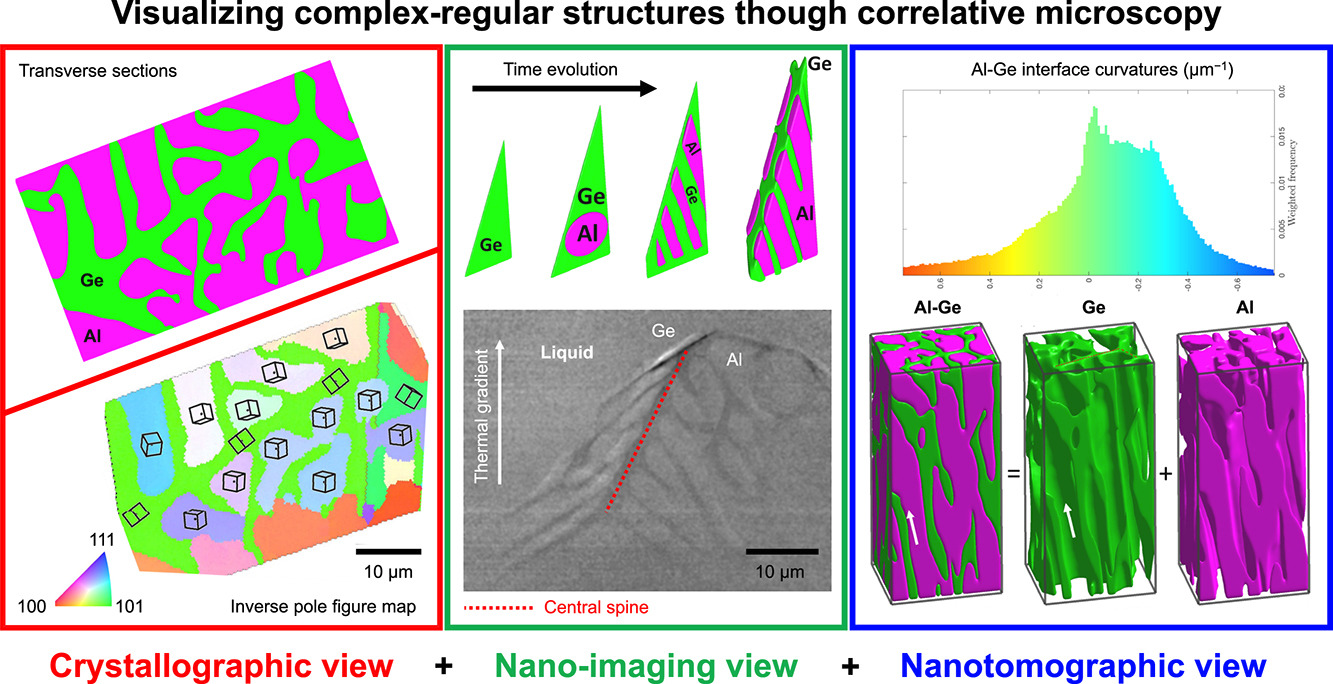
FROM MORPHOLOGY TO MECHANISMView figure ↗Connecting crystallography, growth dynamics and 3D morphology.Al–Ge microstructures viewed through crystallographic mapping, nano-imaging and nanotomography.
RESEARCH APPROACH / ART · SCIENCE · CHARACTERIZATION
Build. Observe. Explain.
The four themes below connect how a material is made to the structures it develops and the evidence needed to understand them.
01 / ART
Art of manufacturing
Design the experiment. Shape the material.
Apparatus development connects a scientific question to the conditions needed to test it. The aim is to bring process design, materials synthesis and three-dimensional quality assessment into a single experimental workflow.
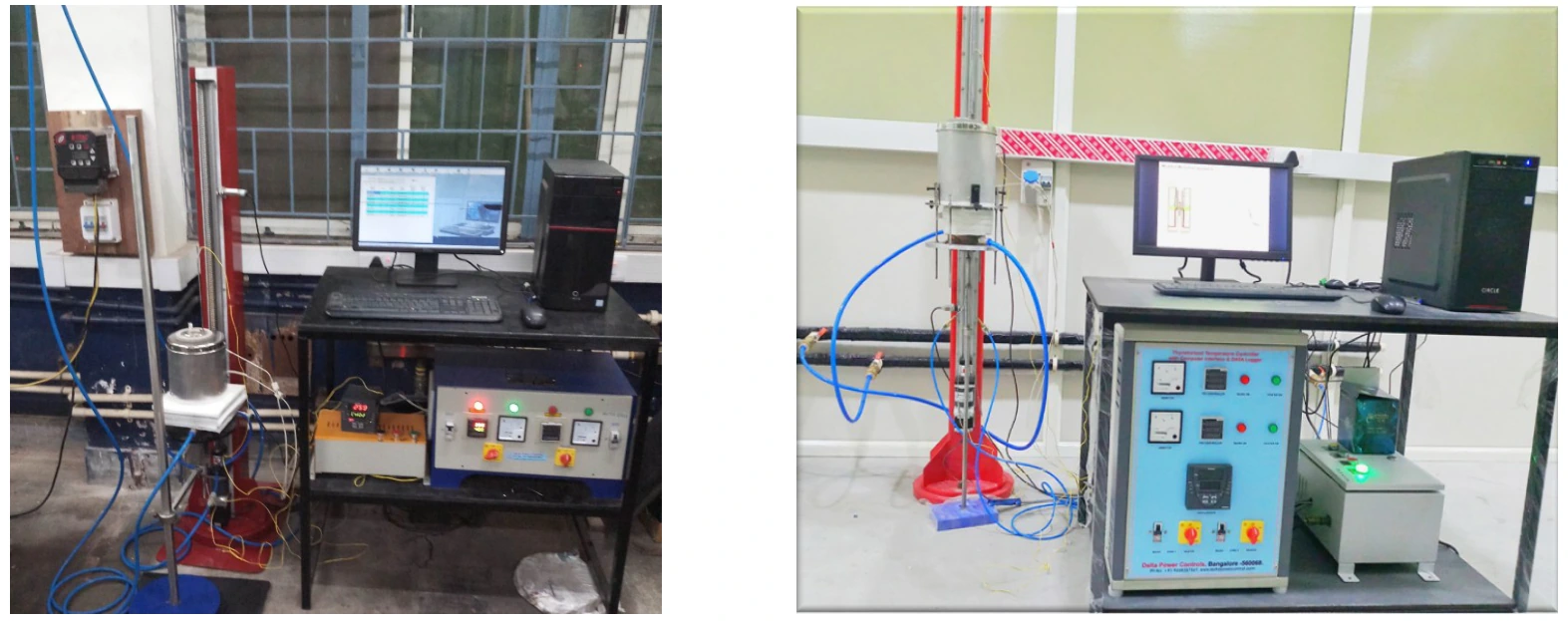
Rapid-solidification apparatus for amorphous ceramics — IIT Madras.
Apparatus for single-crystal growth and directional solidification — IISc Bangalore.
Dendrites, lamellae, rods and branching networks record the competition between transport, growth and interfacial constraints. Their geometry is both visually striking and physically consequential: connectivity, alignment and spacing influence how a material carries heat, current and load.
Exotic eutectic microstructures and multiphase growth.
Peritectic structures in 3D and their evolution during solidification.
Monotectic structures and metal–ceramic composite microstructures.
Eutectic solidification and melt-based crystal growth provide a way to study how thermal conditions, phase competition and crystallography select a structure. Mathematics connects those observations to quantitative descriptions; sustainable metallurgy connects processing choices to materials reuse and performance.
Eutectic solidification and controlled crystal growth.
Mathematics of materials: spatial transforms, thermodynamics, geometry and data analysis.
Sustainable metallurgy: recycling, processing history and microstructure.
Three-dimensional imaging reveals internal phases, defects and connectivity. In-situ measurements follow their evolution during processing. Diffraction and spectroscopy add complementary information about crystal structure, orientation and chemistry, helping connect a visible morphology to its formation mechanism.
3D materials: laboratory and synchrotron X-ray tomography, reconstruction and segmentation.
In-situ imaging: solidification, phase transformations, coarsening and pore evolution.
Fourier and wavelet analysis describe spatial patterns across scales. Interfacial geometry, curvature and connectivity make three-dimensional structures quantitative. Crystallographic representations connect morphology to orientation.
Time-resolved observations add the sequence of events: nucleation, growth, interaction and transformation. Together, these measurements help test mechanisms and guide the next experiment.
Turn processing conditions into experimental variables.
Thermal gradients, interface velocity, solute transport and crystallographic orientation govern how a solid grows. Controlled experiments allow us to examine the transitions between planar, cellular and dendritic interfaces, and the selection of spacing and morphology in multiphase structures.
A central challenge is that the thermal field and interface motion are coupled through heat and solute transport. Purpose-built experiments make that coupling measurable and provide a route to reproducible tests of growth mechanisms.
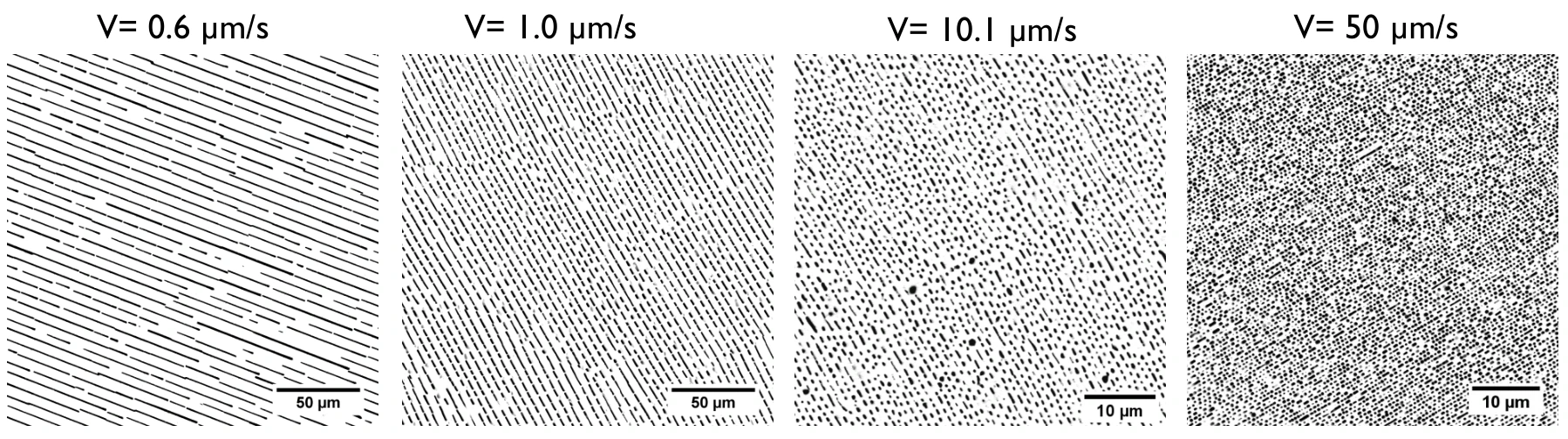
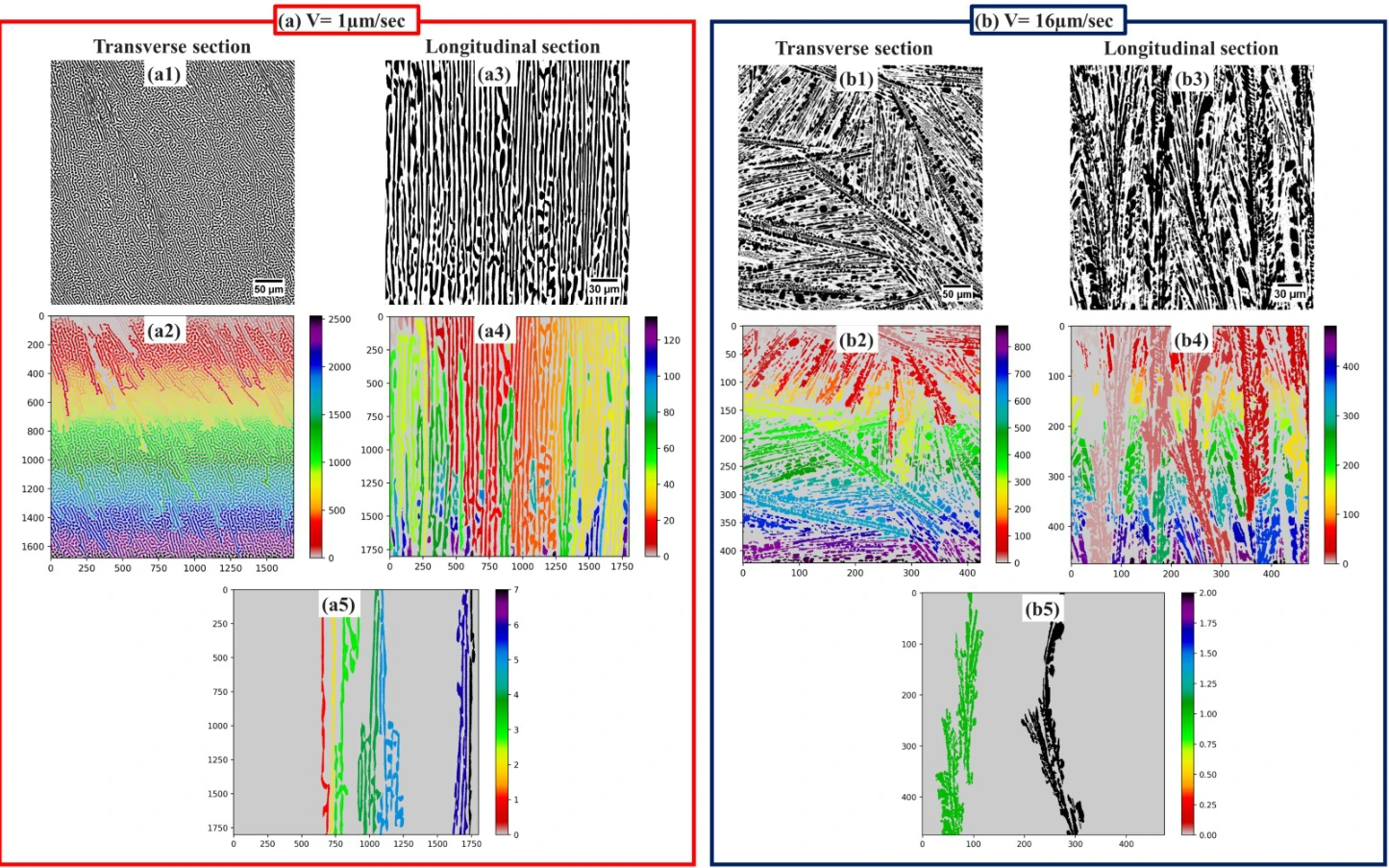
View figure ↗Changing growth velocity changes the eutectic architecture.Transverse sections at a reported gradient of approximately 21 °C/mm. Aramanda et al., Metallurgical and Materials Transactions A 51(12), 6387–6405. Scale bars differ between panels.
Developing experimental platforms is an integral part of my research: combining furnaces, cooling systems, translation drives, sensors and controllers to establish the conditions needed for solidification and bulk crystal growth.
1200 °CMaximum temperature reported for the doctoral apparatus
0.1–1000 μm/sReported range of growth velocities
View figure ↗Custom directional solidification platforms developed from the ground up.Apparatus photographs from Aramanda’s PhD thesis, IISc, Bengaluru.
Subsequent apparatus development extended to high-temperature processing of superalloys and refractory alloys. The next step is coordinated control of multiple heating and cooling zones, with precise measurements of temperature and interface motion.
03 / OBSERVE
Watch a mechanism unfold.
In situ imaging of microstructure evolution
A final microstructure records an outcome. Time-resolved imaging reveals the path.
Optical and synchrotron X-ray imaging follow moving solid–liquid interfaces and phase interactions during eutectic, peritectic and monotectic solidification. These observations help distinguish competing explanations of how complex structures form.
Development work includes an X-ray-compatible solidification apparatus for 2D and 3D imaging at the Indian synchrotron, Indus-2. The research direction is to combine controlled processing with 4D measurements: three spatial dimensions followed through time.
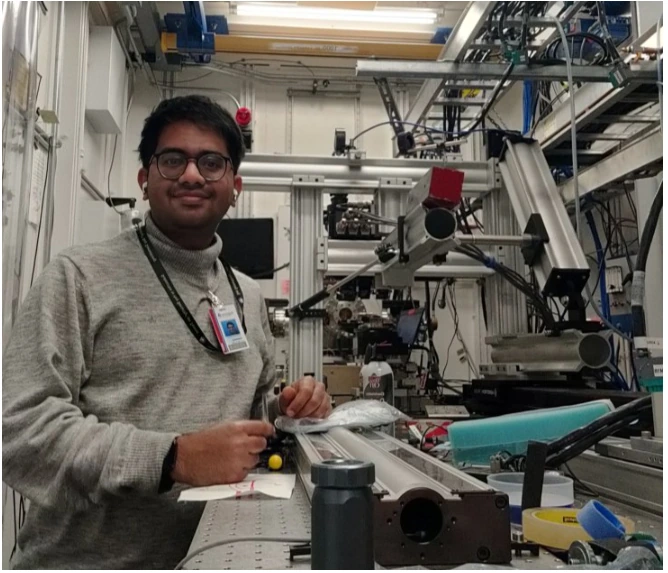
View figure ↗Experiments at the beamline.Photograph from the research presentation, in situ directional solidification study.
Tomography reveals the internal architecture of a material. In-house Python workflows connect raw X-ray projections to reconstructed volumes and quantitative descriptions of phases, interfaces and particles, using open-source tools including Algotom and TomoPy.
PrepareFlat-field and stripe correction, alignment and centre-of-rotation refinement.
ReconstructAnalytical, Fourier-based or iterative reconstruction, selected for the data.
MeasureDenoising, segmentation, 3D visualization and geometry-based analysis.
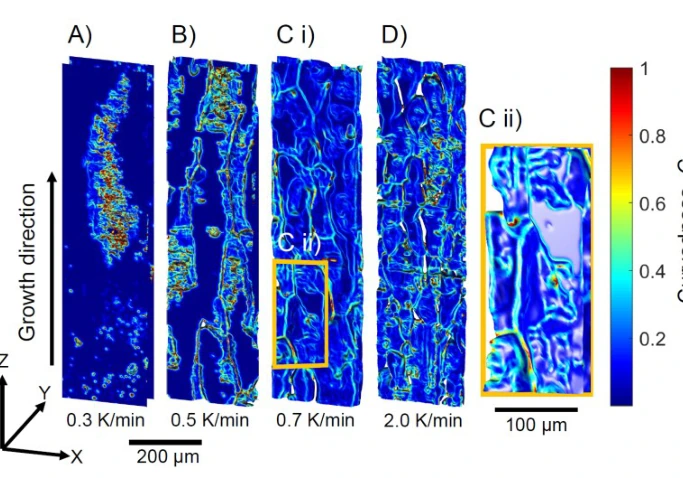
View figure ↗Quantifying the geometry of an evolving interface.Curvedness maps from supplementary material: Lindemann*, Aramanda* et al., Acta Materialia 274 (2024). *Equal contribution.
Measurements include principal curvatures, interface-normal distributions, individual-particle geometry and spatial correlations. Together, they turn visual observations into descriptors that can test a physical mechanism and connect processing to structure.
A morphology alone rarely identifies its origin. Correlative characterization brings crystallographic orientation, local chemistry and internal structure into the interpretation of microstructure evolution.
In situ imaging + EBSDRelate growth trajectories to crystal orientation.
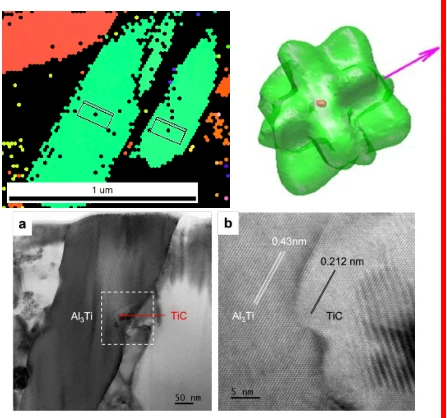
3D tomography + STEM + TKDConnect volume geometry with local crystallography and nanoscale structure.
XRD + TEM + EBSDCompare complementary diffraction and microscopy evidence across scales.
View figure ↗Multiple views of the same structural problem.3D tomography, STEM and TKD example. Gladstein*, Aramanda* et al., Acta Materialia 277 (2024). *Equal contribution.
06 / ENGINEER
Use structure as a design variable.
Different microstructures. Different material responses.
The same alloy can support more than one useful architecture.
Microstructure engineering connects controlled processing to properties through phase arrangement, length scale, texture and connectivity. Thermoelectric materials provide a concrete example: changing how phases grow and align creates a route to tuning their coupled electrical and thermal response.
View figure ↗Processing changes morphology and crystallographic texture within the same alloy system.Thermoelectric microstructure example. Mukherjee*, Aramanda* et al., ACS Applied Energy Materials (2021). *Equal contribution.
Broader directions include self-organized periodic structures, bulk crystals, superalloys and refractory materials—linking a desired function to a microstructure that can be produced and measured.
NEXT DIRECTION / AUTONOMOUS EXPERIMENTS
From observing evolution to steering it.
The next research direction connects these capabilities in a feedback loop: estimate the material state from sensors and images, compare it with a target, and adjust heating, cooling or motion during the experiment.
Multi-loop control, physics-based models and AI-assisted analysis offer a path toward experiments that respond to the evolving microstructure. The goal is purposeful control of interface shape, growth conditions and the structures they produce.
Selected figures and photographs are drawn from the research presentation and credited to the original studies. Click a figure to inspect its labels and scale bars at full size.